

For the past 18 months, geopolitical friction has become the background noise of business.
Wars, sanctions, supply chain disruptions, changing trade agreements, economic nationalism, cybersecurity threats and increasingly competitive relationships between major economies have moved from the pages of international news into boardrooms and budget meetings.
For Canadian tech companies, there’s an additional layer; the increasingly complicated relationship between Canada and the United States.
The temptation is to think, “We are a software company, tariffs are somebody else’s problem.” But unfortunately, it is not quite that simple.
Geopolitical Risk is Now Business Risk
The World Economic Forum’s Global Risks Report 2026 puts the issue rather bluntly. Geoeconomic confrontation is ranked as the top global risk for 2026, with interstate conflict, societal polarization, misinformation and cyber insecurity also among the leading concerns. Half of the more than 1,300 experts surveyed expect the next two years to be turbulent or stormy.
That matters to technology leaders because modern businesses are built on interconnected systems.
Your application may run in one country, use cloud infrastructure from another, depend on an open-source project maintained somewhere else, process data across several jurisdictions and serve customers on both sides of a border.
The code may be Canadian.
But the dependency graph is decidedly international.
This dependency creates several areas where geopolitical instability can become an IT issue.
1. Supply chain resilience
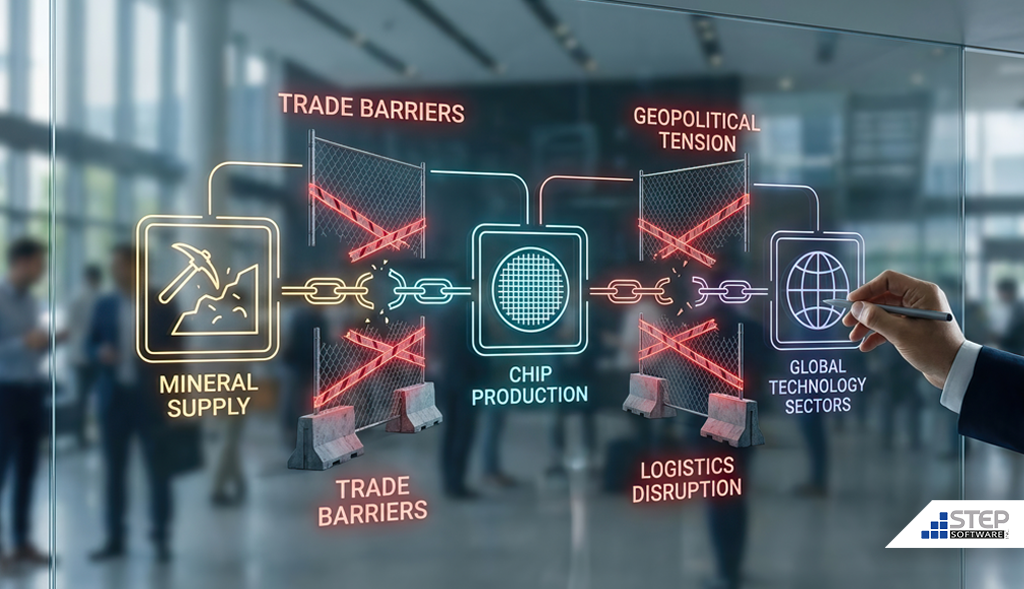
Software has made business more digital, but it has not made business independent of physical supply chains.
Servers, networking equipment, laptops, storage, semiconductors and other technology infrastructure still move through international supply chains. So do many of the components that support the digital economy.
The World Economic Forum identifies geopolitical confrontation and military conflict as major threats to global supply chains.
For technology leaders, this raises practical questions:
- How dependent are we on a single hardware supplier?
- What happens if a critical component becomes unavailable?
- How quickly can we replace a technology vendor?
- Where is our data stored, really?
- Which countries are involved in our technology supply chain?
- What happens if a supplier becomes subject to sanctions or export restrictions?
These are no longer hypothetical questions reserved for multinational corporations.
These now belong in technology risk assessments.
2. Cybersecurity is becoming geopolitical
Cybersecurity has always been a business concern. However, geopolitical instability makes it considerably more complicated.
Canada’s National Cyber Threat Assessment warns that state-sponsored cyber operations against Canada and its allies extend beyond traditional espionage. Threat actors are increasingly attempting disruptive activities, including denial of service, data theft, data manipulation and attacks designed to support military or political objectives.
The assessment specifically identifies Russia, China and Iran as significant state-sponsored cyber threats to Canada, while warning that Canadian organizations can also be exposed through supply chain compromises and cloud-based services.
That means cybersecurity strategy cannot simply be about protecting the corporate network anymore.
Technology leaders should also understand:
- Third-party software exposure
- Cloud and SaaS concentration risk
- Software supply chain vulnerabilities
- Identity and credential management
- Disaster recovery dependencies
- Vendor access
- Data sovereignty
- Business continuity if a critical technology provider becomes unavailable
In other words, the geopolitical environment is making the IT architecture itself part of an organization’s risk profile.
3. Then there is the Canada-US trade relationship
The Canada-US relationship has been remarkably integrated for decades. That integration is now being tested.
As of August 22, 2026, the United States imposed a 50% tariff on $27.6 billion of Canadian goods. Canada subsequently announced counter-tariffs of 15%, 25% and 50% on selected US products, covering approximately $27.6 billion of US products effective September 8, with targeted measures including electronics, appliances, steel and aluminum, among other categories.
The good news for software companies is that this does not mean every Canadian software service suddenly carries a 50% tariff.
The bad news is that the impact of trade friction does not stop at the customs border.
Reuters reported on September 3 that Canada’s trade surplus fell sharply in July, while the share of Canadian exports going to the United States declined to 66.35%, compared with 69.39% in June. Exports to non-US markets increased 7.4% during the month.
That means your technology customers may be changing their behaviour even if your software itself is not directly subject to a tariff.
They may delay projects.
They may reduce discretionary spending.
They may rethink expansion.
They may demand greater efficiency from existing systems.
And, interestingly, that last point can create an opportunity for technology companies.
4. Uncertainty changes technology budgets
When economic conditions become unpredictable, organizations tend to look much harder at technology spending.
That does not necessarily mean technology budgets disappear. It often means the standard for approving spending changes.
“Wouldn’t it be nice?” becomes“What problem does this solve?”
“Let’s replace it” becomes“Can we modernize it incrementally?”
“Let’s buy another platform” becomes “Can we get more value from what we already own?”
Statistics Canada found that businesses responding to tariff pressures were considering strategies including alternative suppliers, domestic sourcing, delaying major expenditures and investing in technology improvements. These are important distinctions.
Uncertainty can suppress technology spending, but it can also increase demand for technology that improves efficiency, resilience and control. For business and technology leaders, this is where modernization becomes strategic rather than cosmetic.
If a legacy application is expensive to maintain but essential to the business, replacing it may not be financially realistic during an uncertain economic period. Modernizing the user interface, improving integrations, exposing APIs, cleaning up data, improving documentation or stabilizing the underlying architecture may provide a much better return.
Sometimes the smartest technology investment is not the newest technology; sometimes it’s making the technology you already have more resilient.
5. Canadian technology businesses need to think beyond the US market
There is another side to this conversation.
Canada’s economy has historically benefited enormously from access to the United States. But geopolitical and trade uncertainty is encouraging Canadian organizations to diversify.

Global Affairs Canada’s State of Trade 2026 reports that Canadian goods trade with the United States declined in 2025 amid tariffs and trade policy uncertainty, while Canada’s non-US export share reached its highest level in more than four decades.
For technology businesses, diversification may be considerably easier than it is for manufacturers.
Canada’s digitally enabled services represented approximately 13% of Canada’s exports in 2025 and have grown substantially faster than goods exports since 2010. Export Development Canada also identifies computer services, information services and research and development as areas where Canada has competitive advantages.
That is an opportunity.
Canadian technology companies can sell expertise internationally without necessarily moving factories, inventory or physical infrastructure across borders.
But diversification requires technology businesses to ask whether their own operations are ready for it.
- Can your systems support multiple currencies?
- Can your contracts accommodate different jurisdictions?
- Can your data architecture support different privacy requirements?
- Can your team support customers in different time zones?
- Can your infrastructure be moved if regulatory requirements change?
- Can your business operate if one major market suddenly becomes less predictable?
These are technology architecture questions, but they are also business strategy questions.
6. What does this mean for technology employees?
This is perhaps the most overlooked part of the conversation.
Geopolitical uncertainty eventually reaches people.
When customers delay spending, businesses may slow hiring. When costs rise, companies may scrutinize compensation and operating expenses. When projects are delayed, technology teams can find themselves managing larger backlogs with fewer resources.
Statistics Canada reported that recruiting skilled employees remained one of the leading obstacles identified by Canadian businesses in the third quarter of 2026, with 25.2% identifying it as an expected obstacle.
This creates a strange contradiction. Organizations may become more cautious about technology spending while simultaneously needing highly skilled technology professionals more than ever.
The answer may increasingly be flexibility.
Instead of attempting to hire every specialized skill permanently, organizations can use a combination of internal teams, specialized consultants, staff augmentation and strategic software development partners.
These approaches can help businesses maintain critical systems and continue modernization projects without committing to a permanent expansion of every capability.
It can also help technology employees avoid the familiar cycle of being asked to maintain yesterday’s systems while simultaneously being expected to build tomorrows.
7. Resilience is becoming a technology strategy
For years, resilience was often treated as a disaster recovery conversation.
Backups, redundancy, recovery time objectives, business continuity; these things still matter. But resilience now needs to include geopolitical resilience.
Business leaders should understand where their critical technology dependencies live, who controls them, how replaceable they are and what happens if access changes unexpectedly.
That means conducting regular reviews or audits of:
- Critical software and infrastructure dependencies
- Vendor concentration
- Cloud providers and regions
- Data residency
- Cybersecurity exposure
- Software supply chains
- Legacy system dependencies
- Disaster recovery capabilities
- Documentation and institutional knowledge
- Internal technical skills
- External technical support options
The objective is not to eliminate every risk, that’s impossible.
The objective is to understand which risks could stop the business and make sure there is a plan for them.
The Opportunity Hidden Inside the Uncertainty
There is a tendency to talk about geopolitics as if businesses are simply passengers on a train heading somewhere unpleasant.
That is not entirely true.
Businesses still have choices, they can:
- Diversify suppliers
- Modernize strategically
- Strengthen cybersecurity
- Reduce unnecessary technical debt
- Document critical systems
- Build flexible technology architectures
- Invest in their people
- Diversify markets
And they can stop treating technology as a collection of projects and start treating it as part of the organization’s resilience strategy.
Canada’s current trade situation is a useful reminder that stability should never be confused with permanence. For decades, Canadian businesses could reasonably assume that the Canada-US economic relationship would remain predictable. Today, that assumption requires more qualification.
The same lesson applies to technology.
The system that has always worked may continue to work, the vendor you’ve always used may remain available, the supply chain you’ve always relied on may remain intact.
Strong technology leadership is not about predicting exactly what happens next; it’s about making sure the business can adapt when something changes. That is the real value of resilient software architecture, and in an increasingly unpredictable world, adaptability may be the most valuable asset a business can own.
At STEP Software, we help businesses assess, stabilize and modernize the software they already depend on, while building technology strategies that support what comes next. Drop us a line if you are feeling the pressure and need guidance on how to keep your tech stack flexible and resilient.


