

Your IT infrastructure may be busier than you think. Not because your development team launched a major application or your customer base doubled, but because Marketing introduced a new automation platform, Sales added another CRM integration, or someone adopted a third-party service to improve the customer experience.
Individually, these decisions make business sense. Collectively, they can increase API consumption, bandwidth requirements, processing demands and infrastructure costs.
And who gets to explain the unexpected increase to finance? Usually, IT.
As businesses tighten up their 2027 IT budgets, web services traffic management deserves a seat at the table. Budgeting for servers, software licences and infrastructure upgrades is no longer enough. Organizations also need to understand how their applications communicate, what those interactions cost and whether that activity is delivering tangible business value.
It is time to budget for the traffic your business creates (now and forecasted), not just the technology it owns.
Web Services Traffic Is Not Just an IT Metric
Modern B2B businesses depend on interconnected applications, including:
- CRM, ERP, and accounting platforms.
- Marketing automation and customer portals.
- Payment processing and transaction services.
- Business intelligence and reporting tools.
- Cloud storage and document management.
- Identity management and security services.
- Third-party APIs and AI-powered applications.
Every connection generates activity. Some applications exchange information only when an event occurs. Others continuously communicate, periodically check for updates or process thousands of background requests.
Many cloud and web services providers charge according to consumption, including API requests, data transfers, processing, storage, and monitoring. For example, Amazon API Gateway charges according to API calls and data transferred, while Google Cloud API Gateway charges for API operations.
The result? Infrastructure costs can increase even when the underlying application environment remains relatively unchanged. The meter keeps running.
What Should B2B Businesses be Budgeting for in 2027?
Web services costs vary according to architecture, transaction volumes, service providers and business requirements. However, several recurring expenses deserve attention during annual IT budget planning.
| Service | What drives the cost |
| API management | Request volumes, capacity, and service tiers |
| Cloud hosting and compute | Processing, memory, and automatic scaling |
| Data transfer and bandwidth | Outbound traffic and network routes |
| CDN services | Bandwidth and content delivery requests |
| Web application security | WAF, DDoS protection and bot management |
| Database services | Queries, connections, storage, and processing |
| Monitoring and observability | Hosts, logs, metrics, and application traces |
| Backup and disaster recovery | Storage, replication, and recovery requirements |
| Third-party integrations | Usage tiers, transactions, and licensing |
Since most organizations already pay for several of these services, the challenge becomes that they are often managed separately. This disparate approach makes it difficult to understand the total cost of supporting business applications.
A few real-world pricing examples illustrate the potential impact:
- Data transfer: Google Cloud network pricing lists applicable North American outbound traffic at approximately $0.105 USD per GB in its first standard pricing tier. Microsoft Azure bandwidth pricing lists $0.087 USD per GB for the next 10 TB of North American outbound internet traffic after its initial 100 GB allowance. An additional 2 TB per month could therefore represent roughly $2,000 to $2,600 USD annually, depending on provider and pricing terms.
- API management: Google Cloud API Gateway lists $3 USD per million calls in its applicable usage tier. An additional 18 million billable calls monthly would cost approximately $648 USD annually, excluding associated infrastructure and data transfer.
- Application monitoring: Datadog lists Application Performance Monitoring starting at $31 USD per host per month with annual billing. Ten hosts at that entry price represent $3,720 USD annually.
These are illustrative published rates, not a complete infrastructure budget. Add hosting, databases, security, logging, backups and software subscriptions, and the fiscal impact becomes considerably more significant.
The takeaway: usage-based expenses deserve the same scrutiny as software licences and infrastructure contracts.
The Marketing Campaign That IT Didn’t Know About
One of the biggest challenges technical business leaders face with increased web services traffic is that the consumption does not always originate in IT.
Consider the impact when a department introduces new technology:
Marketing: Thanks tomarketing automation tools a successful campaign drives more website visits, triggering analytics, personalization requests and CRM lookups. More engagement is good news, but it also creates additional processing and data transfer.
Sales: A new synchronization between sales CRM and the company ERP platforms repeatedly checks for customer updates. Poorly configured polling can generate thousands of unnecessary API requests.
Customer Service: A new self-service portal gives customers access to orders, account information and service requests. Every interaction creates backend requests, database queries and authentication activity.
AI-powered features: An AI assistant or automated document-processing service introduces external API calls and potentially significant consumption-based charges. Costs that look manageable during testing can change quickly when customers begin using the feature regularly.
None of these departments are necessarily making bad decisions. However, their attempt to improve business performance and business improvement does not end with the initial software purchase.
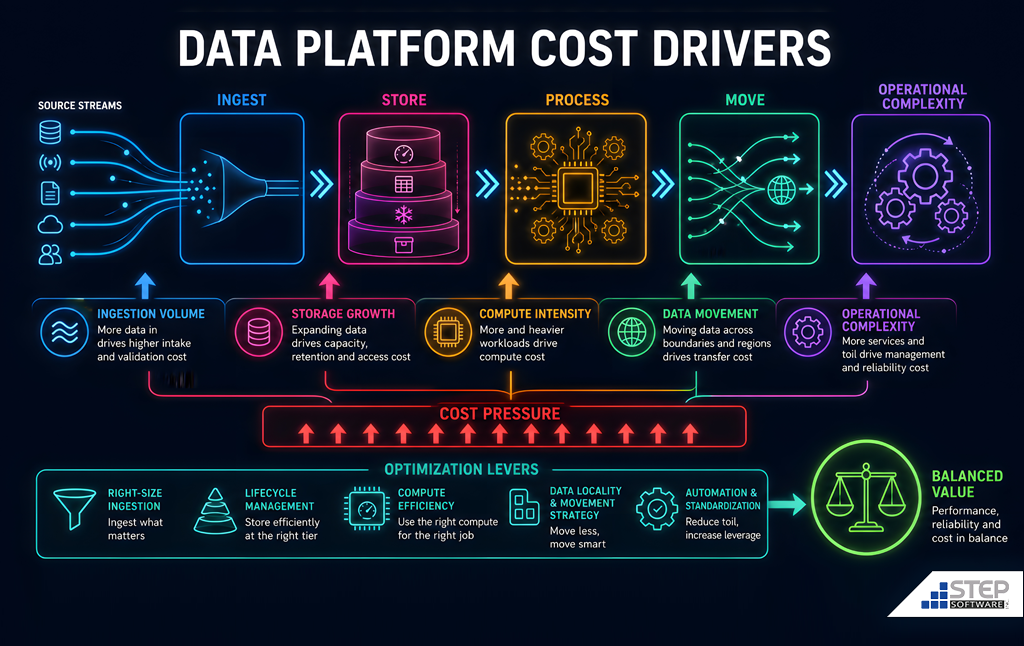
Key takeaway: IT needs to be included earlier in these decisions. New applications, integrations and campaigns should have an infrastructure impact assessment before implementation; not a reactive budget review after an exorbitant monthly cloud invoice arrives.
Traffic Optimization: The 2027 Opportunity
The answer is not to discourage growth or restrict departments from adopting useful technology. It is to make sure the systems supporting that growth operate efficiently.
The FinOps Foundation’s 2026 State of FinOps Report surveyed 1,192 respondents representing more than $83 billion in annual cloud spending. Workload optimization and waste reduction remain important priorities, with financial management increasingly extending beyond cloud infrastructure into SaaS, licensing, and AI spending.
For B2B organizations, several practical optimization strategies can help:
- Audit API usage. Identify high-volume integrations, repeated requests, and unnecessary polling. GitHub’s API best-practice guidance recommends webhooks instead of repeated polling where appropriate, reducing unnecessary requests.
- Improve caching and content delivery. Frequently requested information does not always need to be retrieved from the original application or database. Appropriate caching and CDN configurations can reduce repeated processing and improve response times.
- Review application performance and scaling. Look for inefficient database queries, underused infrastructure, unnecessary processing, and services that are not scaling appropriately to demand.
- Monitor consumption by application and department. An overall cloud bill shows what the organization spent, but not necessarily which application or business function caused the increase. Usage reporting can provide much-needed visibility.
- Establish traffic thresholds and alerts. Unexpected increases in API calls, bandwidth or processing should trigger investigation before they become expensive surprises. Rate limiting and anomaly detection can also help protect against runaway consumption and malicious traffic.
How a Third-Party Software Firm Can Help
IT teams already have plenty to manage, from maintaining business-critical applications to addressing security risks, delivering new projects and keeping legacy software running. A comprehensive review of web services traffic can be difficult to fit into an already crowded schedule.
An experienced third-party software development partner can provide an independent technical assessment of your environment.
This can include:
- Reviewing cloud invoices and identifying unusual spending patterns.
- Mapping APIs, integrations, and application dependencies.
- Identifying unnecessary requests and inefficient data synchronization.
- Evaluating application performance, database usage and infrastructure capacity.
- Reviewing caching, CDN and traffic management configurations.
- Identifying opportunities to right-size existing resources.
- Establishing usage benchmarks and realistic cost forecasts.
- Developing a prioritized optimization roadmap.
This does not necessarily mean replacing applications or undertaking a major modernization project. Sometimes meaningful savings come from fixing an inefficient integration, adjusting a polling interval, or optimizing a database query.
A trusted software partner can also provide ongoing application maintenance, performance monitoring and on-call support, giving internal IT teams access to additional technical expertise without expanding permanent staffing requirements.
The objective is simple: get more value from the technology you already own.
Make Web Services Optimization Part of Your 2027 IT Strategy
Before finalizing your 2027 IT budget, consider five practical steps:
- Establish a baseline: Document current API calls, bandwidth, cloud consumption and monitoring costs.
- Identify ownership: Connect applications and integrations to the departments using them.
- Forecast growth: Include planned marketing of communications campaigns, sales initiatives, AI features and new integrations.
- Budget for optimization: Allocate resources for technical assessments and application improvements.
- Review quarterly: Compare actual consumption against forecasts and investigate unexpected increases.
Growing web services traffic is not inherently a problem. On the contrary, it can mean more customers, stronger engagement, and better business performance. But increased consumption without visibility and optimization can turn business success into an unexpected IT expense.
Is your business paying for web services it doesn’t need, or missing opportunities to get more from the infrastructure it already has?
STEP Software helps B2B organizations understand, stabilize, and optimize the software environments their businesses depend on. Our custom software development, legacy system support, application maintenance and technical advisory services can help identify inefficiencies, improve integrations and make existing systems work harder.
Don’t make another infrastructure increase your first response to rising traffic. Start with a better understanding of what is driving it.
Connect with STEP Software to discuss an application and web services assessment and make optimization part of your 2027 IT budget strategy.


