

You know the risks are accumulating. Your budget committee wants to know why they should pay to fix them now.
If you lead an IT team, this conversation probably feels familiar.
You have unsupported software that needs attention, dependencies that have not been reviewed, legacy applications that nobody wants to touch, and security findings that keep getting pushed to next quarter. Your team knows these issues will not resolve themselves but when budget season arrives, the pushback begins.
Cybersecurity debt can be difficult to explain to people who see only the cost of fixing it, not the risks associated with leaving it to grow.
October’s Cyber Security Awareness Month is a good time to alter that conversation. With 2027 budget planning well underway, the objective now is not to convince leadership to spend more on security simply because the threats are growing. It is to show them which risks the business is carrying, what those risks could cost left unaddressed, and what a realistic plan to reduce them looks like.
Cybersecurity Debt is Already on Your Balance Sheet
Cybersecurity debt accumulates when vulnerabilities, outdated dependencies, weak access controls, undocumented integrations and other security weaknesses remain unresolved.
Some of this debt is visible in vulnerability reports. Some sits in legacy applications that have not been independently assessed in years. Some exists because a third-party vendor changed a component, a developer left, or an application became too complicated for your current team to maintain confidently.
The problem is not that every outstanding issue represents an imminent breach. The problem is that you cannot prioritize risk effectively if you do not know its extent, ownership or business impact.
This is where cybersecurity debt differs from a conventional maintenance backlog. A delayed feature might inconvenience users. An unresolved security weakness could expose customer information, interrupt operations or create a route into other connected systems.
STEP Software has explored the related challenge of technical debt and its impact on IT teams, budgets and modernization. Cybersecurity debt adds another dimension: the longer you postpone understanding and addressing certain weaknesses, the less control you may have over when they demand attention.
The Financial Case Is Getting Harder to Ignore
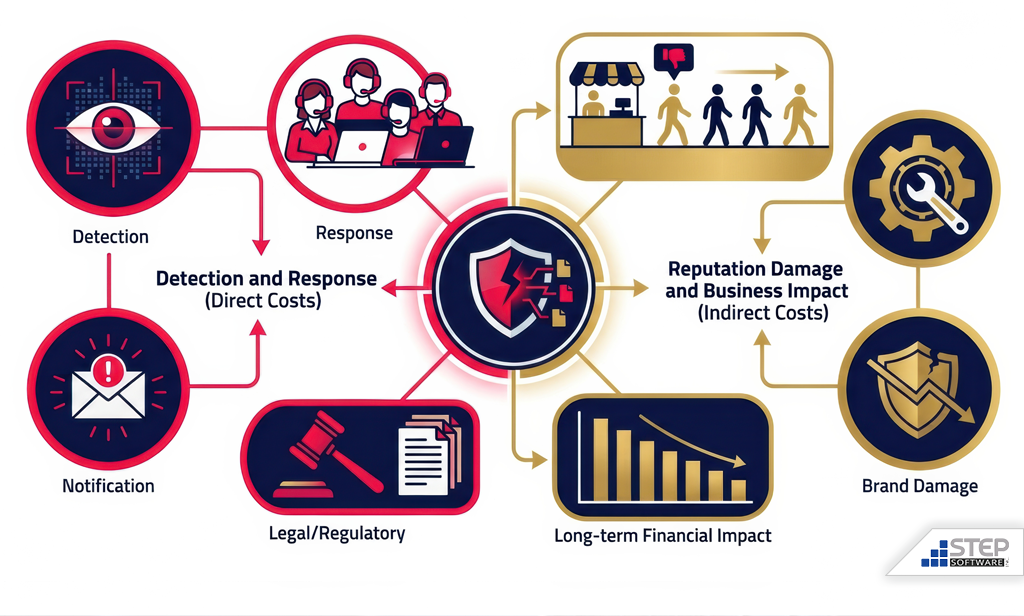
According to IBM’s 2026 Cost of a Data Breach Report, the average cost of a data breach in Canada reached CA$7.11 million, a record high in the study. The average breach involved approximately 28,500 compromised records and took 205 days to detect and contain.
These figures represent the study’s average, not a prediction of what a breach would cost your organization. However, they demonstrate the financial scale of the problem.
The Verizon 2026 Data Breach Investigations Report found that exploitation of software vulnerabilities accounted for 31% of breaches, making it the leading initial access method in the report.
For technical leaders, the budget implication is straightforward. If known weaknesses remain unresolved because teams lack time, expertise or funding, the organization is effectively accepting risk without necessarily measuring it.
That is a difficult position to defend when something goes wrong. It is also an opportunity to make a more compelling case before it does.
Stop Asking for a Bigger Security Budget, Start Showing What It Will Buy
A request for additional cybersecurity funding becomes much easier to evaluate when it is connected to specific outcomes.
Instead of asking for a general increase in security spending, build your 2027 proposal around three priorities:
1. Find Out What You Are Carrying
Fund an independent assessment of business-critical applications, particularly legacy and custom software where documentation is incomplete, or ownership is unclear. Establish which vulnerabilities, dependencies and architectural weaknesses deserve attention.
STEP’s software audit services can help identify security concerns, outdated components, maintainability issues and technical debt. The result should be a prioritized view of the work, not simply another list of problems.
2. Put a Price on Remediation
Separate urgent fixes from work that can be scheduled. Estimate the effort, cost, dependencies and business impact of addressing each priority. Identify risks that require immediate action and those that can be managed through planned maintenance.
This gives finance leaders something concrete to evaluate what that investment addresses, what the organization will spend, and what exposure remains if the work is deferred.
3. Fund Prevention, Not Just Cleanup
Include ongoing vulnerability management, software maintenance, documentation, dependency reviews and security testing in the operating budget. Otherwise, today’s remediation project can become next year’s backlog.
Track measures such as the age of unresolved critical vulnerabilities, time to remediate, unsupported components and the percentage of critical applications with current security assessments. These indicators help demonstrate progress and explain future funding requirements.
Your Vendors Can Add to the Debt or Help You Pay It Down
Third-party software development and support can be part of the solution, but outsourcing does not automatically reduce risk.
A vendor that delivers poorly documented code, introduces unnecessary dependencies or leaves security responsibilities unclear can create more work for an already stretched IT team.
The right partner can provide specialist expertise, independent assessment and additional capacity to address a backlog without requiring permanent headcount increases.
NIST’s Cybersecurity Supply Chain Risk Management guidance emphasizes assessing suppliers and communicating cybersecurity expectations throughout the supply chain.
For 2027 planning, review whether your vendors can help you reduce measurable risk. Ask how they manage vulnerabilities, document dependencies, test code and support applications after deployment.
STEP’s Advisory Division offers guidance on software assessments, code reviews and practical action planning while our Legacy Software Division helps organizations stabilize, maintain and modernize existing applications. This unique combination of skills offers clients options to modernize without a full rip and replace.
Staff Augmentation support can be particularly valuable when the expertise required to resolve a security issue is not available internally, or when the internal team is already committed to keeping critical systems running. It is also a budget conscious method of keeping systems secure while ensuring your modernization efforts don’t lose focus.
Make Your 2027 Budget a Risk Decision
Cyber Security Awareness Month reminds us that security is everyone’s responsibility. For IT leaders, that includes making sure the business understands the risks embedded in its own technology.

You do not need to eliminate every vulnerability or modernize every legacy system in 2027. But you do need a defensible plan that identifies the most important risks, assigns ownership, funds the right interventions and measures whether the backlog is shrinking.
That’s a much stronger budget conversation than simply asking for money to improve cybersecurity.
At STEP Software, we help organizations understand the condition of their software and determine practical next steps, whether that means a security audit, targeted remediation, better documentation or a longer-term modernization plan.
Before your 2027 budget is finalized, ask yourself three questions:
- Do we know where our biggest cybersecurity debt sits?
- Can we explain the business consequences of leaving it unresolved?
- Do we have a funded plan to reduce it?
If the answer to any of these is no, the first investment may not be another security tool. It may be getting a clearer picture of the software you already own.
Because when you are asking leadership to fund risk reduction, evidence is a much stronger argument than fear.
Drop us a line if you need help answering any of these questions..


