

Remember when the biggest workplace concern about technology was spending too much time in meetings? Today, a new phenomenon is quietly making its way into boardrooms, project teams, and office conversations. It has an unofficial name that is surprisingly descriptive: AI Brain Fry.
It is not a medical diagnosis, or a term found in a psychology textbook (yet). Instead, it is the growing feeling of mental fatigue, cognitive overload, and reduced critical thinking that can occur when employees rely heavily on generative AI throughout the workday.
For business leaders, this is more than a cheeky workplace term; it’s becoming a business issue that affects productivity, innovation, employee development, risk management, and budgets.
The irony is hard to miss. The very tools designed to make us work smarter can, if used without balance, make us think less.
What Is AI Brain Fry?
AI Brain Fry has been described as the mental exhaustion and reduced cognitive engagement that some workers experience after spending extended periods interacting with AI tools. Instead of analysing problems, brainstorming solutions, or writing from scratch, employees increasingly prompt AI systems, review responses, make edits, and repeat the process dozens or even hundreds of times each day.
The work may feel easier, but it often requires a different type of concentration.
Microsoft’s 2025 Work Trend Index found that employees are experiencing an ‘infinite workday’ as AI accelerates expectations for productivity, increasing the volume of information and decisions workers process rather than reducing them.
Research from Harvard Business School also suggests that while generative AI can significantly improve productivity for many knowledge tasks, over-reliance may reduce opportunities for learning, experimentation, and independent problem solving, particularly among less experienced employees.
In other words, AI can make people faster, but it does not automatically make them better thinkers.
Why This Is Becoming a Business Problem
Most discussions about AI focus on technology implementation, and how to get it into the budget.
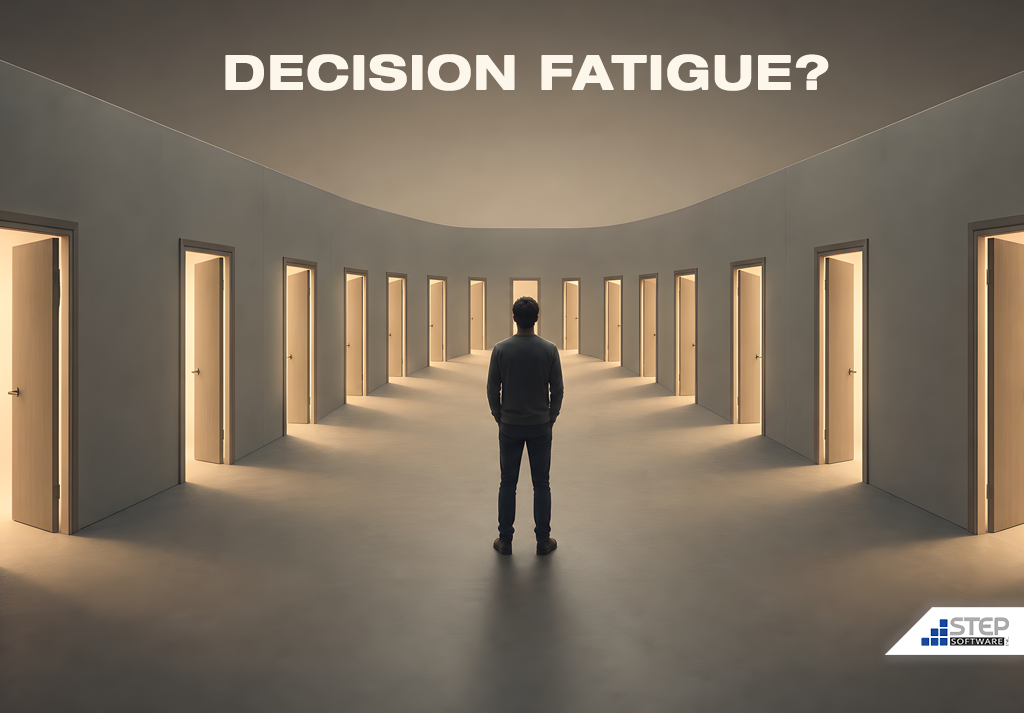
The bigger challenge, however, may be the impacts on human performance.
Employees who spend their day evaluating AI-generated content often report:
- Decision fatigue
- Difficulty concentrating
- Reduced confidence in their own judgement
- Less creative thinking
- Increased mental exhaustion
The World Economic Forum’s Future of Jobs Report 2025 warned that AI adoption will require organisations to invest heavily in human skills such as analytical thinking, creativity, resilience, and lifelong learning because these abilities will become more valuable, not less, as automation increases. We touched on this recently in our blog Humans in an AI Time.
So, what does this mean for businesses?
The effects are company wide:
- Marketing teams reviewing dozens of AI-generated campaigns may struggle creatively
- Developers validating AI-written code may lose confidence
- Legal teams checking AI-assisted contracts may face decision fatigue
- Finance professionals reviewing AI-produced analyses may question their judgement
- Customer service representatives refining AI-generated responses may become mentally exhausted
- Everyone still needs to think critically, but HR gets to deal with the back lash from all the departments
The Hidden Cost of Convenience
One of AI’s greatest strengths is reducing repetitive work. One of its greatest risks is reducing ‘productive struggle.’
Stanford professor Jo Boaler sings the praises of ‘embracing the struggle’ when it comes to learning, psychologists concur on the value of doing things the hard way.
Consider a junior software developer.
Ten years ago, they might spend several hours researching documentation, testing different approaches, making mistakes, and eventually solving a problem.
Today, AI may generate a working solution in seconds.
This sounds like progress, and often it is.
But, if developers never learn why the solution works, organisations risk creating teams that can implement code but struggle to troubleshoot, optimise, or innovate when AI cannot provide the answer. We touched on this back in February in our blog: AI Coding Agents: Yes, Maybe, or No?
These same principles apply across accounting, engineering, marketing, human resources, and operations departments.
Efficiency without understanding creates organisational risk
Why Budgets Should Be Part of the Conversation
At first glance, AI Brain Fry appears to be a people issue, but the financial implications are real.
Consider this:
- If employees require more time to verify AI output, productivity gains shrink
- If poor AI decisions create compliance issues, costs increase
- If employees experience higher levels of mental fatigue, absenteeism and turnover can rise
Gallup estimates that employee disengagement costs the global economy trillions of dollars annually through lost productivity. While AI is not the sole cause of disengagement, organisations should ensure technology improves work rather than simply increases the pace.
Businesses investing heavily in AI must invest equally in developing critical thinking, governance, training and AI literacy.
AI Needs Adults in the Room
Generative AI works best when paired with experienced professionals. It is an assistant not an autopilot.
Successful organisations are establishing practical guidelines encouraging employees to:
- Verify AI-generated information
- Understand outputs before using them
- Continue developing technical and professional expertise
- Use AI to accelerate work, not replace judgement
- Take regular screen breaks to reduce cognitive fatigue
Think of AI like GPS, it is incredibly useful, but, if you follow every instruction without paying attention to the road, eventually you are going to end up somewhere unexpected.
Building a Healthier AI Workplace
Business leaders can reduce AI Brain Fry by creating a balanced approach to AI adoption.
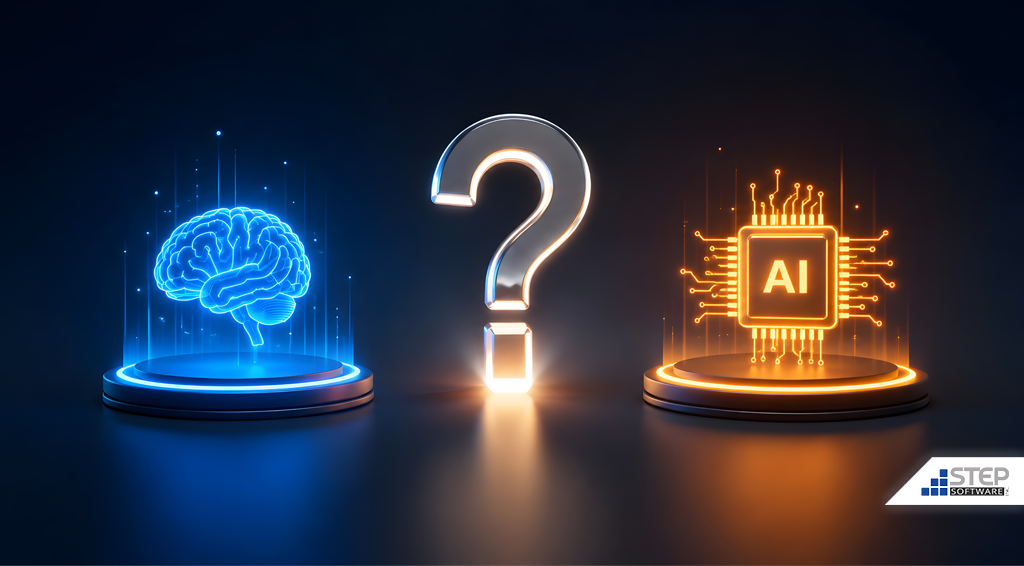
Some practical strategies include:
Invest in AI literacy. Employees should understand both the strengths and limitations of generative AI.
Encourage independent thinking. Not every task needs an AI prompt. Brainstorming, strategic planning, and problem solving still benefit from human collaboration.
Protect deep work. Constant prompting and reviewing AI outputs fragments attention. Dedicated time for uninterrupted work improves focus and creativity.
Review workloads. AI often increases expectations rather than reducing them. Ensure productivity targets remain realistic.
Support continuous learning. Employees should continue developing their technical expertise instead of relying solely on AI-generated answers.
How STEP Software Can Help
Many organisations are discovering that successful AI adoption is less about the technology itself and more about implementation.
Introducing AI without governance, training, or process improvements can create confusion instead of efficiency.
At STEP Software, we help organisations modernise technology while keeping people at the centre of the solution.
Whether developing AI-ready applications, integrating new technologies into existing systems, modernising legacy platforms, or providing experienced software professionals through staff augmentation, our focus is on helping businesses use technology strategically.
Sometimes the best way to improve productivity is not by asking your existing team to do more; its by bringing in experienced specialists who can accelerate projects, mentor internal teams, and provide the expertise needed to implement technology effectively.
Final Thoughts
AI Brain Fry may sound like a trendy phrase, but the challenge behind it is real.
As organisations embrace AI across every department, success will depend on maintaining the balance between automation and human expertise.
Technology should reduce repetitive work; it should not reduce critical thinking.
Businesses that invest in both AI and their people will be better positioned than those relying on technology alone.
After all, artificial intelligence may be getting smarter every month; but the real competitive advantage belongs to organisations filled with people who know when not to ask the robot.
Our advisors are here to help, drop us a line if you are feeling the AI Brain Fry in real-time.


