

For years, data cleansing has been treated like a back-office IT task, important, but rarely urgent.
Things have changed.
In the era of AI, automation, cybersecurity threats, and digital transformation, clean data has become a business-critical asset.
Organizations investing millions into modernization initiatives are discovering a hard truth: bad data quietly destroys software projects, weakens AI systems, increases cybersecurity risk, and drives up operational costs.
For business leaders responsible for technology budgets, the conversation is no longer about whether data optimization matters; it’s about whether the organization can afford to keep ignoring it.
Hidden Costs of Bad Data
Poor-quality data impacts every area of modern business:
- Inaccurate reporting
- Failed software integrations
- Unreliable AI outputs
- Operational inefficiencies
- Compliance risks
- Frustrated employees
- Poor customer experience and engagement
According to IBM’s research on poor data quality, over one quarter of organizations estimate they lose more than $5 million annually due to poor data quality, while 7% report losses exceeding $25 million per year.
Those costs rarely appear as one obvious budget line. Instead, they spread quietly across the organization.
Do any of these issues sound familiar?
- Delayed projects
- Duplicated work
- Manual corrections
- Failed migrations
- Inaccurate forecasting
- Growing technical debt
If you answered yes, welcome to the club. These are the symptoms most companies feel long before they identify the root cause – bad data!
AI Is Making Data Problems Impossible to Ignore
AI has amplified the importance of clean data, dramatically.
Businesses everywhere are deploying:
- AI copilots
- Analytics platforms
- Automation tools
- Predictive models
- Generative AI systems
But AI systems are only as reliable as the data feeding them, the computer science concept of GIGO (garbage in – garbage out) applies now, more than ever.
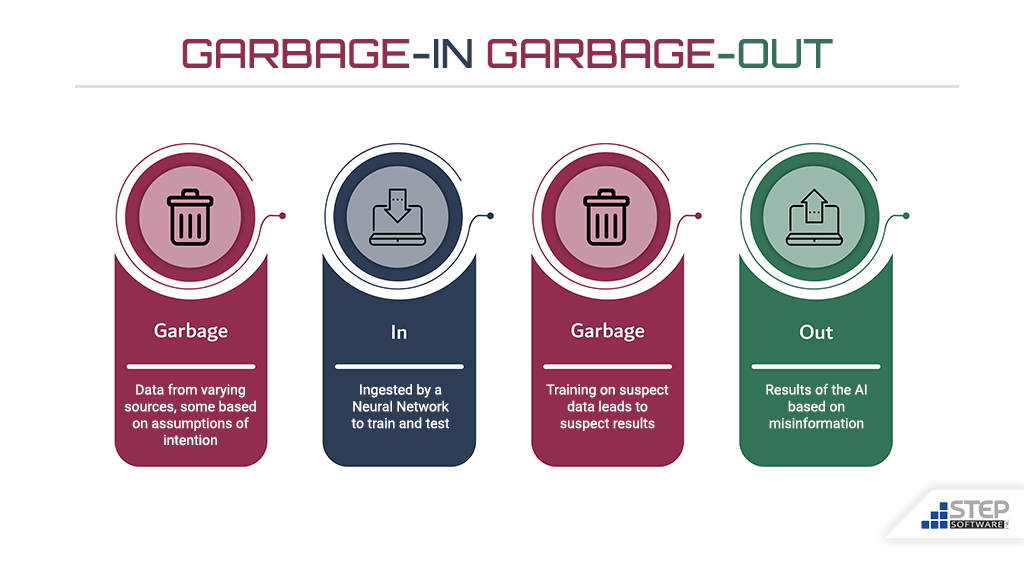
If customer records are duplicated, AI recommendations become inaccurate. If operational data is inconsistent, forecasting models fail. If legacy systems contain incomplete records, automation workflows break. The cycle continues.
Gartner recently reported that 63% of organizations either lack or are unsure whether they have AI-ready data practices in place. Even more concerning, Gartner predicts organizations will abandon 60% of AI projects unsupported by AI-ready data through 2026.
Those statistics alone should be setting off the executive warning bells. The issues are not always the AI technology itself, its often the condition of the organization’s data infrastructure.
Legacy Systems Making the Problem Worse
Legacy modernization, while it is the goal, it is still a very real struggle for most modern businesses. The challenge of carrying decades worth of fragmented data environments into the modernization roadmap are making the efforts monumentally more difficult.
Older systems were not built for:
- Cloud-native applications
- AI integration
- Real-time analytics
- Modern cybersecurity requirements
- End user UI expectations
Over time, organizations have layered spreadsheets, disconnected databases, custom applications, and duplicate systems on top of aging infrastructure, resulting in fragmented architecture and disparate systems.
The ongoing operational challenges are real:
- Departments maintaining conflicting records
- Inconsistent or inaccurate reporting mechanisms
- Data no one fully trusts
- Growing storage costs, redundant data is not free
IBM notes that poor data quality often stems from:
- Weak governance
- Outdated systems
- Integration failures
- Inconsistent data collection practices
The problems poor data quality causes during software modernization projects are a list all their own. Businesses frequently discover their biggest obstacle is not implementing innovative technology but cleaning the data being migrated into it.
Underestimating The Cybersecurity Risk
Bad data is not just an operational problem, its increasingly becoming a cybersecurity issue.
Fragmented systems and poor governance create:
- Inconsistent access controls
- Unknown data exposure
- Shadow AI usage
- Unknown compliance vulnerabilities
Recent discussions on Reddit, surrounding the new ‘AI usage control’ issued by Gartner, highlight the growing concerns about organizations losing visibility into how company data is being shared with external AI systems.
In other words: poor data governance is now directly connected to cybersecurity exposure and as AI adoption accelerates the risks grow.
Internal Teams Struggle to Solve This Alone
Most IT departments already operate at or below effective capacity levels. We talked about the impacts on employee mental health last week on our blog, but the impacts go beyond this.
Internal teams are balancing:
- Cybersecurity
- Infrastructure support
- Software maintenance
- AI implementation
- Cloud migration
- Simultaneous operational support
- Legacy software and modernization initiatives
Large-scale data optimization projects require:
- Dedicated expertise
- Governance frameworks
- Automation tooling
- Sustained focus without attention fragmentation
Optimization efforts are difficult to achieve internally when they are a team’s sole focus but forget about it when that team is also managing day to day operations. This is why many organizations are turning to third-party firms to champion their optimization efforts.
A Third-Party Optimization Partner is Good Business Sense
For many executives, outsourcing data cleansing sounds like an added expense when it should be viewed as a strategic cost-control initiative.
Experienced third-party firms bring:
- Specialized expertise
- Proven methodologies
- Automation capabilities
- External objectivity
- Additional skillsets to augment support needs (like custom software development)
More importantly, they can identify problems internal teams often normalize after years of working around them.
An experienced optimization partner can help organizations:
- Consolidate fragmented systems
- Improve governance
- Modernize legacy systems and integrations
- Reduce duplicate data
- Prepare environments for AI
- Strengthen security controls
Accelerating modernization efforts while reducing long-term operational costs is a budget win. Because once poor-quality data spreads into modern systems, remediation becomes significantly more expensive.
Getting Budget for Data Optimization
The challenge of getting approved budget for data optimization projects is a common challenge we are hearing from our advisory clients.
The issue is perception.
Data cleansing sounds operational. AI sounds strategic.
But the reality is that AI success depends on data quality.
Without clean, governed, optimized data:
- AI initiatives fail
- Modernization slows
- Cybersecurity risk increases
- Software projects become more expensive
- Employee frustration grows
This is not maintenance work anymore, it’s infrastructure modernization and one of the most important prerequisites for successful digital transformation projects.
Final Thoughts
Businesses are investing heavily in AI, automation, cloud infrastructure, and software modernization. But many are still trying to build those initiatives on unreliable data foundations.
That’s like adding floors to an office building while ignoring cracks in the foundation.
Businesses that succeed over the next decade will not simply be the ones that buy or implement the newest AI tools, they will be the ones that prioritize data health first.
Because in modern business, clean data is no longer an IT luxury, it’s a competitive advantage.
Drop us a line if you are looking for a reliable, experienced partner to help with your data optimization projects.

